

Cognitive Behavioural Therapy (CBT) Melbourne
Cognitive Behavioural Therapy, commonly known as CBT, is a practical and evidence-based form of psychological therapy. Originally created by Aaron Beck in 1960s, it considered the ‘gold standard’ of treatments for many mental health conditions.
Working with a CBT therapist involves developing a clearer understanding of your difficulties and practising strategies that can create meaningful, lasting change in your life.
What is Cognitive Behavioural Therapy and How Does It Work?
CBT is based on the idea that our thoughts, emotions, physical sensations and behaviours are interconnected. A change in one area can affect the others.
For example, if you think you will embarrass yourself in a social situation (thought), you may feel anxious (feeling) and avoid speaking (behaviour). Avoidance can bring short-term relief, but it may also reinforce the belief that social situations are frightening, therefore keeping your anxiety going.
A cognitive behavioural therapist helps you identify cycles like these and understand what may be maintaining them. Therapy might involve examining unhelpful interpretations, changing patterns of avoidance or practising new ways of responding.
CBT usually focuses on difficulties affecting you now, while also considering how your experiences and beliefs developed. It is collaborative, structured and adapted to the individual.
The Cognitive Behavioural Therapy Model Explained
The CBT model considers four core parts of an experience that can be triggered by a situation:
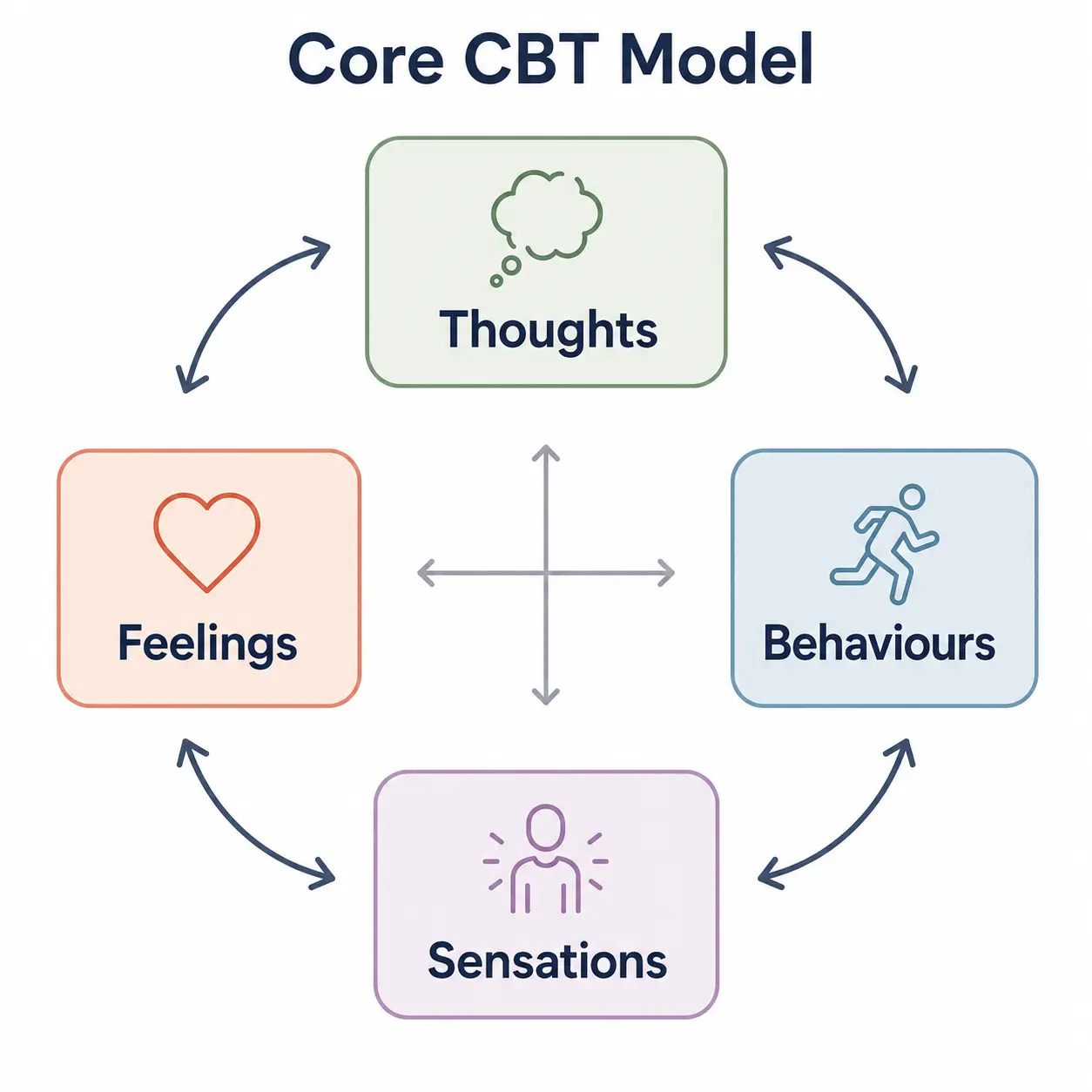
As the image suggests, these parts can influence one another in different directions. An anxious thought might lead to physical tension in the body, and avoidance as a behaviour. Equally, feeling physically anxious may make you more likely to interpret an uncertain situation negatively.
CBT helps you slow this process down and identify where change may be possible. This does not mean that distress is caused entirely by your thinking or that difficult circumstances do not matter. Instead, CBT explores whether certain interpretations or responses may be increasing your distress or keeping a problem going.
What does CBT Look Like in Real Life?
Imagine you are asked to give a big presentation at work. You think, “I’ll lose my train of thought and everyone will think I’m incompetent.” This thought increases your anxiety, and you begin looking for a way to avoid presenting.
A CBT therapist might help you identify unhelpful thoughts or cognitive distortions, such as catastrophising or mind reading. They would then help you challenge these thoughts by examining the evidence for your prediction, develop a more balanced perspective, and build your confidence by gradually practise exposure to your fear by speaking in front of others.
In another example, you might wake up feeling low and think, “There’s no point getting up.” You stay in bed and cancel your plans, which reduces opportunities for connection, enjoyment and achievement, and ultimately results in your low mood persisting. CBT may involve challenging the hopeless conclusion while also learning to take small, manageable steps to improve your mood, such as showering, going outside or completing one small task.
A cognitive behavioural therapist can also help you learn how your feelings shape your thoughts. When you are already anxious, for example, you may be more likely to interpret someone’s brief response or facial expression as criticism.
Increasing insight into your own patterns gives you the skills to be able to increasingly manage your feelings and thoughts on your own. You may also have tasks to complete between sessions to help this happen more quickly.’
What Problems Can Cognitive Behavioural Therapist Help With?
CBT is one of the most extensively researched psychological therapies, and is the ‘gold standard treatment’ for many conditions. It can be used with adults, adolescents and children, and has been adapted for a wide range of concerns.
A cognitive behavioural therapist may help with:
- Depression and low mood
- Generalised anxiety and worry
- Panic attacks and Panic Disorder
- Social Anxiety
- Specific phobias
- Obsessive Compulsive Disorder
- Trauma and Post-Traumatic Stress Disorder
- Eating disorders
- Health anxiety
- Insomnia and sleeping difficulties
- Stress and burnout
- Perfectionism
- Low self-esteem
Whilst CBT may be the first-line treatment for these conditions, the most suitable treatment still depends on your symptoms, circumstances and preferences. A psychologist will consider these along with the evidence base to determine which treatment best suits your needs.
CBT Isn’t Just Positive Thinking: Common Misconceptions
Because it’s so well known, CBT sometimes suffers from misconceptions. A big one is that it’s all just positive thinking.
Unlike toxic positivity, CBT does not ask you to replace every negative thought with a positive one. Its aim is to help you think in ways that are more balanced, flexible and grounded in evidence.
For example, “I struggle in social situations” may be accurate. “I will never succeed at anything” is a much broader conclusion that may not be supported by the facts.
CBT also involves more than discussing thoughts. Behavioural strategies are central to the approach and may include gradually approaching something you fear, changing an unhelpful routine or reducing reassurance seeking.
Other common misconceptions include:
CBT ignores the past
Although CBT usually focuses on how thoughts, feelings, behaviours and sensations affect you in the present, earlier experiences are often explored when they help explain current beliefs and coping patterns.
A CBT therapist will tell me my thoughts are wrong
Good therapy is collaborative. Your psychologist should help you examine your thoughts with curiosity rather than dismissing them.
CBT is also less about deciding whether a thought is “right” or “wrong” and more about understanding where it comes from, how accurate it is in the present situation, and whether it is helping you. For example, the thought “I will be rejected” may have developed from past experiences where rejection did occur. CBT can help you notice when an old expectation is being applied to a new situation and consider whether there may be other possibilities.
CBT is just worksheets and homework
Written exercises can be useful and may be used, but they should support meaningful therapeutic work rather than become an end in themselves.
Is Cognitive Behavioural Therapy the Right Fit for You?
CBT may be a good fit if you:
- Are experiencing a concern for which CBT has a strong evidence base, like those listed above
- Become caught in worry, self-criticism or unhelpful predictions
- Avoid situations because they make you uncomfortable or anxious
- Understand some of your patterns but are unsure how to change them
- Would like practical strategies alongside discussion and reflection
- Have particular goals you would like to work towards
- Are interested in the connections between thoughts, feelings and behaviour
You do not need to know whether CBT is right for you before making an appointment. Your psychologist can assess what you are experiencing, discuss your goals and recommend a suitable approach.
What Happens if CBT Doesn’t Work?
An unsuccessful experience of CBT does not mean that therapy cannot help you.
You may not have found the right psychologist. The therapeutic relationship is important, and it can be difficult to make progress when you do not feel understood or comfortable. If this happens, you could give feedback to your psychologist, or seek to be rematched to someone who better suits your preferred style and needs.
The treatment may also have been too general or insufficiently tailored to your situation. CBT for depression, panic, OCD and trauma should not look exactly the same.
Sometimes, although CBT might be the first option for treatment, for various reasons another form of therapy may be more appropriate. Schema Therapy may suit people experiencing longstanding beliefs or relationship patterns that are resistant to change, while Acceptance and Commitment Therapy offers a different way of responding to difficult thoughts and feelings that some people may prefer. Other people may benefit from trauma-focused therapy like EMDR, or a more emotion-management focussed treatment like Dialectical Behaviour Therapy. Most of these approaches are derived from CBT principles, but have a slightly different focus that may suit someone if traditional CBT does not resonate.
External circumstances can also affect progress, including ongoing stress, unsafe relationships, physical illness or limited support.
If CBT has not helped, it is important not to assume that you have failed, or therapy has failed you. Discussing your concerns, changing psychologists or trying another therapeutic approach may lead to a better outcome.
Our CBT Therapists
At Peaceful Mind Psychology, our psychologists use CBT to support people experiencing a broad range of mental health concerns.
We believe effective CBT involves more than applying a standard set of techniques. A warm and trusting relationship provides the foundation for exploring difficult experiences and trying new ways of responding.
Your psychologist will take time to understand your concerns, how they developed and what may be maintaining them. They will then tailor therapy to your needs, goals, personality and pace.
Our large team allows us to thoughtfully match clients with a psychologist based on their presenting concerns and preferences. Our CBT therapists also draw on other evidence-based approaches, allowing treatment to evolve as your treatment needs do.
CBT Appointments in Melbourne and via Telehealth
CBT is equally evidence-based whether delivered in person, or by a telehealth psychologist.
You can attend in person appointments at our comfortable psychology clinics in Melbourne, located in Armadale, Prahran, Hawthorn and Glen Iris. Our rooms provide a calm, welcoming and private environment in which you can speak openly with your psychologist.
We also offer CBT therapy via Telehealth. Online therapy may be more convenient if you have a busy schedule, live further away, find travel difficult or prefer attending from home.
Whether you attend in person or online, your psychologist will work collaboratively with you to understand your concerns and develop a treatment plan suited to your needs.
Find a Cognitive Behavioural Therapist in Melbourne
Finding the right psychologist can feel difficult, especially when you are already overwhelmed. Our friendly team are highly experienced at matching you with a psychologist based on your concerns, preferences and appointment needs.
To learn more about CBT or arrange an appointment with one of our Melbourne psychologists, call 1300 766 870 or submit an enquiry through our online form.
| Locations | |
|---|---|
| Service Area | |
|---|---|
- How many CBT sessions will I need?
There is no set number that suits everyone. CBT is often relatively structured and time-limited, but the length of therapy depends on the nature, complexity and duration of your concerns. Your goals, progress and whether you are managing several difficulties will also affect the number of sessions required. Your psychologist can give you a clearer recommendation after completing an initial assessment.
- What happens during a CBT session?
A CBT session usually begins with a discussion of how you have been and what would be most helpful to focus on. You may examine a recent situation, identify a pattern and learn or practise a relevant strategy. Your psychologist may also suggest something to observe or try before your next appointment. Sessions should remain flexible enough to address important issues as they arise, as well as working towards your overarching goals.
- Does CBT involve homework?
In order to increase efficiency of therapy, a CBT therapist may suggest practising strategies between sessions. This might include recording certain thoughts, gradually approaching an avoided situation, changing part of your routine or testing a prediction. These activities should have a clear purpose and be planned collaboratively, taking your circumstances and capacity into account.
- What's the difference between a CBT therapist and a psychologist?
A CBT therapist is a practitioner who provides Cognitive Behavioural Therapy. It is not a separate protected professional title in Australia. Many registered psychologists are trained in CBT and undertake further professional development in specialised CBT treatments. When choosing a therapist, it is helpful to consider both their qualifications and their experience treating your particular concern.
- Can CBT make anxiety worse at first?
Some CBT techniques, particularly exposure therapy, may temporarily increase anxiety. Exposure involves gradually approaching something you fear rather than continuing to avoid it, in order to overcome your fear in the long run. This should be carefully planned and completed at a manageable pace. Tell your psychologist if any aspect of therapy feels overwhelming, so the approach can be reviewed and adjusted.